

Ethical sourcing for carrier oils isn't just about quality - it's about protecting ecosystems, supporting fair labor, and ensuring transparency. Carrier oils like jojoba, sweet almond, and coconut oil are essential in wellness and skincare, but their production can harm the environment and exploit workers if done irresponsibly. Here's why ethical sourcing is crucial:
- Environmental Impact: Overharvesting and harmful extraction methods damage ecosystems, as seen with the 40% decline in Morocco's argan forests.
- Worker Welfare: Many laborers, especially women, earn only a fraction of what the oils sell for in global markets.
- Product Quality: Ethical practices, like cold-pressing, preserve nutrients and avoid harmful chemicals, ensuring better oils for your skin.
To choose ethically sourced oils, look for transparency (e.g., origin details, certifications like Fair Trade or USDA Organic) and sustainable practices (e.g., cold-pressed, unrefined oils). Ethical sourcing benefits not just the planet and workers but also the quality of the products you use daily.
Simple Sourcing Ideas for High Quality Carrier Oils
The Problems with Unethical Carrier Oil Sourcing
The surge in demand for plant-based oils has skyrocketed - increasing by over 75% in value over the last twenty years. While this growth reflects their popularity, it also puts immense strain on supply chains, often leading to practices that prioritize profits at the expense of both the environment and human welfare.
Environmental Damage and Overharvesting
Excessive harvesting is wreaking havoc on ecosystems. For example, Morocco's argan forests have diminished by 40%, largely due to overharvesting and overgrazing. These trees are more than just a source of oil; they act as a natural barrier against desertification from the Sahara. Their decline is a growing ecological crisis.
"Because argan trees acted as a green curtain protecting a large part of southern Morocco against the encroaching Sahara, their slow disappearance has become considered as an ecological disaster." - Zoubida Charrouf, Chemist and Argan Researcher, Université Mohammed V
Adding to the problem, industrial extraction methods, such as using n-hexane (a known hazardous air pollutant), compound environmental damage. These unsustainable practices not only destroy ecosystems but also reduce the potency of the oils being produced.
Worker and Community Exploitation
The human cost of unethical sourcing is equally troubling. In some argan-producing areas, women who perform the labor-intensive task of cracking nuts by hand earn as little as $3 for two full days of work. Meanwhile, the finished oil sells for $60 or more in Western markets.
"The people who sell the final product are the ones making the money." - Jamila Id Bourrous, President, Union of Women's Argan Cooperatives
This imbalance extends beyond Morocco. In the Amazon, local producers of Copaíba oil often receive minimal compensation for their raw materials, while intermediaries pocket the bulk of the profits. Without transparent sourcing practices, consumers are left in the dark about whether the workers at the start of the supply chain are being treated fairly.
How Unethical Sourcing Affects Product Quality
Cutting corners in sourcing doesn’t just harm people and the planet - it also impacts the quality of the oils themselves. Unsustainable practices deplete natural supplies, forcing suppliers to dilute their products with cheaper fillers like sunflower or soybean oil. This directly reduces the therapeutic potential of the final product.
On top of that, conventional refining processes strip oils of their beneficial properties. High-heat treatments (up to 450°F), along with bleaching and chemical deodorization, remove essential fatty acids, vitamins, and polyphenols. While the result may look clean and neutral, it lacks the rich nutrients and qualities expected from responsibly sourced oils.
These challenges highlight the urgent need for ethical sourcing practices that prioritize both environmental preservation and fair treatment of workers.
The Benefits of Ethical Sourcing for People and the Planet
Ethical sourcing stands in stark contrast to the harm caused by unsustainable practices. By prioritizing responsible methods, it supports ecosystems, workers, and consumers, offering a more balanced approach to production.
Protecting Biodiversity Through Responsible Farming
Regenerative farming methods are at the heart of ethical sourcing. These practices, such as cover cropping, crop rotation, and reduced tillage, not only avoid harmful chemicals but also restore soil health, improve water retention, and capture carbon from the atmosphere. Instead of relying on monocultures, many ethical farms adopt polycultures, integrating aromatic plants into diverse plantings. This approach naturally reduces pest issues while boosting pollinator populations.
Sustainable extraction methods also play a key role. For instance, the "drilling and tapping" process used for harvesting Copaíba oil involves collecting resin from small, carefully made holes in the tree trunk, leaving the tree unharmed.
"Sustainable harvesting makes trees more valuable standing than cut down, creating economic incentives for forest conservation." - Larissa Assugeni, Global Marketing Specialist for Brazilian Biodiversity, Beraca (Clariant)
To protect endangered species like Sandalwood and Frankincense, ethical producers follow strict harvesting schedules and invest in reforestation and seed propagation efforts. These measures ensure that biodiversity thrives while supporting long-term ecological balance.
Supporting Fair Trade and Local Communities
Ethical sourcing goes beyond environmental benefits by uplifting local communities. Fair trade partnerships ensure workers receive fair wages and safe working conditions, directly benefiting rural areas where these plants are cultivated.
In Morocco, partnerships for harvesting Damask roses have led to better facilities for women, including access to washrooms, break rooms, and childcare. Similarly, in Romania's Carpathian Mountains, the sustainable collection of wild arnica provides farmers with additional income, encouraging them to preserve natural meadows.
Cooperative models take this a step further by giving workers a say in decision-making and a share in the profits. This shifts the dynamic from mere employment to a meaningful partnership. As Asher Wilder aptly put it:
"Community empowerment isn't charity; it's a partnership." - Asher Wilder
Brands like Beyond Bohemian highlight the scalability of this approach, sourcing over half of their inventory from worker-owned cooperatives in South America and Africa. These models prove that ethical sourcing can be both impactful and practical.
Building Consumer Confidence Through Transparency
For consumers who rely on carrier oils for wellness or mindfulness, understanding a product’s origins matters. Ethical sourcing delivers this through detailed transparency. This includes information like botanical names, origins, cooperative details, and even batch-specific lab results. Technologies like blockchain are taking transparency to the next level, enabling "seed-to-bottle" traceability. Consumers can now verify a product’s ethical status and its exact origin, ensuring both authenticity and quality.
"When you can trace a bottle of lavender essential oil back to a specific farm, a specific harvest, and a specific distillation batch - that's when you know you're getting something real." - AromaSentia
Transparency doesn’t just build trust - it guarantees superior product quality. Oils from sustainably managed, nutrient-rich soils tend to have better phytochemical profiles compared to those from conventional farming methods. This shows that ethical sourcing benefits not only the planet but also the products we use every day.
sbb-itb-a2327d8
How to Choose Ethically Sourced Carrier Oils
Understanding the importance of ethical sourcing is just the first step. Here's how to identify and verify carrier oils that align with ethical and sustainable practices.
Signs of Ethical Sourcing to Look For
Start by examining the label. A reliable product will include the full botanical name, the country of origin, and, ideally, details about the region or cooperative where the plant was grown. Be cautious of vague terms like "globally sourced" or "imported", as they often lack transparency.
The processing method is another key indicator. Look for terms such as "cold-pressed", "virgin", or "unrefined" - these suggest minimal processing, which helps maintain the oil's quality and often reflects sustainable practices. Additionally, sustainable packaging, like dark glass bottles, can indicate a commitment to preserving both the oil and the environment.
Certifications provide an extra layer of assurance. Some of the most trusted ones include USDA Organic, Regenerative Organic Certified (ROC), Fair Trade, and Rainforest Alliance. These certifications address different aspects of ethical production:
| Certification | Main Focus | Social Welfare | Transparency |
|---|---|---|---|
| Regenerative Organic (ROC) | Soil health + social outcomes | Required | High |
| USDA Organic | Input restrictions | Varies | Medium |
| Fair Trade | Worker welfare & pricing | Required | Medium |
| Rainforest Alliance | Biodiversity & landscape | Required | Medium-High |
| Conventional | No standards | Varies | Low |
"The most sustainable oil is not always the one with the loudest eco language. It is usually the one you can verify, use fully, store correctly, and buy again from a transparent supply chain." - Maya Thornton, Senior SEO Editor, Oils.live
Once you've identified these signs, the next step is verifying the claims to ensure the product truly aligns with ethical standards.
How to Check Sourcing Claims and Certifications
Start by confirming any certification badges on the product. Check the details of the auditing body, such as QAI or USDA, to ensure they are relevant and legitimate.
Requesting a batch-specific Certificate of Analysis (COA) or a GC/MS report tied to the bottle's lot number is another critical step. If a company can't provide this data, it could be a warning sign. Adulteration is a common issue - lavender oil, for example, is sometimes diluted with cheaper fillers - so having access to batch-level information is crucial.
Price can also be a useful indicator. Suspiciously low prices for rare oils like Sandalwood or Rosehip often suggest quality compromises or unethical sourcing. When in doubt, start with a small bottle to test the product's consistency before committing to larger purchases.
Ethical vs. Unethical Sourcing: A Side-by-Side Look
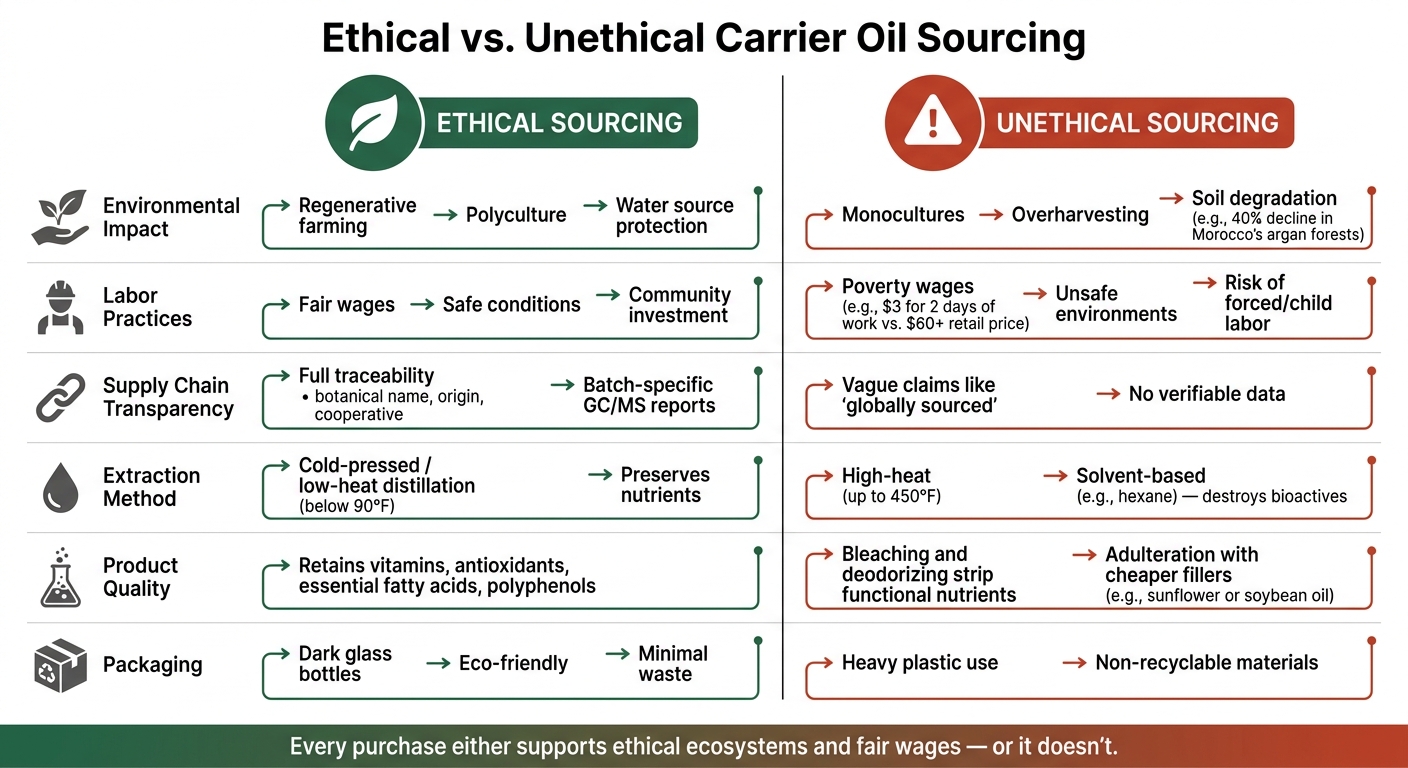
Ethical vs. Unethical Carrier Oil Sourcing: Key Differences
When you place ethical and unethical sourcing side by side, the differences become striking. These practices don't just impact product quality - they ripple through soil health, worker conditions, and even the survival of certain plant species.
Comparison Table: Ethical vs. Unethical Sourcing
| Aspect | Ethical Sourcing | Unethical Sourcing |
|---|---|---|
| Environmental Impact | Practices like regenerative farming, polyculture, and safeguarding water sources | Reliance on monocultures, overharvesting, and soil degradation |
| Labor Practices | Fair pay, safe working conditions, and investment in local communities | Exploitation through poverty wages, unsafe environments, and risks of forced or child labor |
| Supply Chain | Detailed traceability, including batch-specific GC/MS reports | Vague claims such as "sourced globally" with little transparency |
| Extraction Method | Low-heat methods like cold-pressing (below 90°F) | High-heat or solvent-based methods (e.g., hexane), reaching up to 450°F |
| Product Quality | Preserves nutrients like vitamins, antioxidants, and bioactive compounds | Processes like bleaching and deodorizing strip away functional nutrients |
| Packaging | Eco-friendly options like dark glass and minimal waste | Heavy use of plastic and non-recyclable materials |
This comparison highlights how sourcing decisions directly shape the final product, from its purity to its environmental footprint.
Extraction techniques, in particular, play a crucial role. Take lavender oil as an example: its key compounds, linalool and linalyl acetate, are highly sensitive to heat. High-temperature processing can break down these compounds, reducing the oil's effectiveness even if the scent remains intact. By contrast, ethical, low-heat distillation preserves these delicate molecular structures, ensuring maximum efficacy.
Ethical sourcing also protects biodiversity. Oils derived from endangered species, like sandalwood, frankincense, and rosewood, face significant threats from illegal trade and overharvesting. Without a transparent supply chain, the production of these oils isn't just a quality concern - it actively contributes to the decline of at-risk species.
"Ethical sourcing isn't just good for people - it's good for performance. It helps businesses avoid risk, build resilience and attract customers who expect accountability." - Olivia Thomson, Communications Manager, Sedex
Conclusion: Why Ethical Sourcing Should Matter to You
The challenges of production and the importance of ethical practices highlight how every carrier oil choice impacts more than just your wellness routine. Each bottle you purchase either contributes to healthier ecosystems and fair wages for workers - or it doesn't. As seen in the comparison table above, ethical sourcing significantly influences soil quality, worker livelihoods, biodiversity, and even the effectiveness of what you apply to your body.
The scale of production adds urgency to this issue. Creating just one gallon of oil requires vast amounts of raw plant material, meaning careless harvesting can lead to the irreversible loss of slow-growing plant species.
"If we keep taking from the planet without considering our impact, we risk 'species depletion': the irreversible loss of species because of human overuse and exploitation." - Tisserand Aromatherapy
When you choose ethically sourced oils, you’re directly supporting fair wages and sustainable farming practices. Organizations like Fairoils, for instance, connect over 12,137 small-scale farmers across Africa into cooperatives. These groups receive seeds, education, and fair payment for crops such as cinnamon bark and ylang-ylang. Certifications like Fair Trade, USDA Organic, or FairWild ensure that your purchase benefits the growers and their communities.
Beyond ethics, there’s a practical advantage for your wellness. As herbalist Janice, founder of InVine Botanicals, explains:
"The herbs are the reason to reach for a botanical product, but what carries them determines whether they actually arrive."
Unethical processing often strips away the nutrients that make carrier oils effective, while ethical sourcing preserves their natural benefits. By choosing these oils, you’re not only enhancing your well-being but also protecting the environment.
At Rivendell Spiritual Gifts, we are committed to offering only ethically sourced carrier oils. This way, your wellness journey aligns with sustainable practices that uplift both people and the planet.
FAQs
How can I tell if a carrier oil is ethically sourced?
To find carrier oils that are sourced responsibly, focus on brands that go beyond flashy marketing and offer clear, detailed information. Look for specifics like the botanical names, the oil’s place of origin, and whether it comes from cooperatives that support local communities. Certifications such as USDA Organic or Fair Trade are reliable signs of ethical sourcing, as they often reflect fair wages and community support.
For the best quality, choose cold-pressed oils, as this method preserves the oil’s natural properties. Ethical companies are transparent about their supply chains, showing a commitment to both environmental care and fair treatment of the people producing the oils.
Which certifications matter most for ethical carrier oils?
Certifications such as USDA Organic, QAI, or ECOCERT focus on sustainable farming methods but often don't tackle labor rights or social equity. For a more comprehensive look at ethical practices, consider certifications like Fair Trade (e.g., FairTSA) for fair labor standards, Leaping Bunny for cruelty-free products, or B Corp for corporate accountability. Since no single label guarantees everything, trustworthy brands stand out by offering clear sourcing details, independent audits, and third-party testing to confirm both purity and ethical commitments.
How does processing change a carrier oil’s quality?
Processing methods play a big role in determining the quality and properties of a carrier oil. Cold-pressed or unrefined oils are packed with natural nutrients, such as antioxidants and polyphenols, which are crucial for maintaining healthy skin. On the other hand, industrial refining often involves chemicals and high heat. This process not only removes these beneficial nutrients but can also produce harmful byproducts. To get the most out of your oils - whether for wellness or aromatherapy - opt for minimally processed options that maintain their natural botanical goodness.
Related Blog Posts
- 10 Essential Oils for Energy Cleansing
- How to Blend Carrier Oils for Dry Skin
- How Carrier Oils Enhance Essential Oil Benefits
- Ultimate Guide to Carrier Oils for Skincare
Stock your ritual shelf with our oils and blends.
Shop oils & aromatherapy ✨