

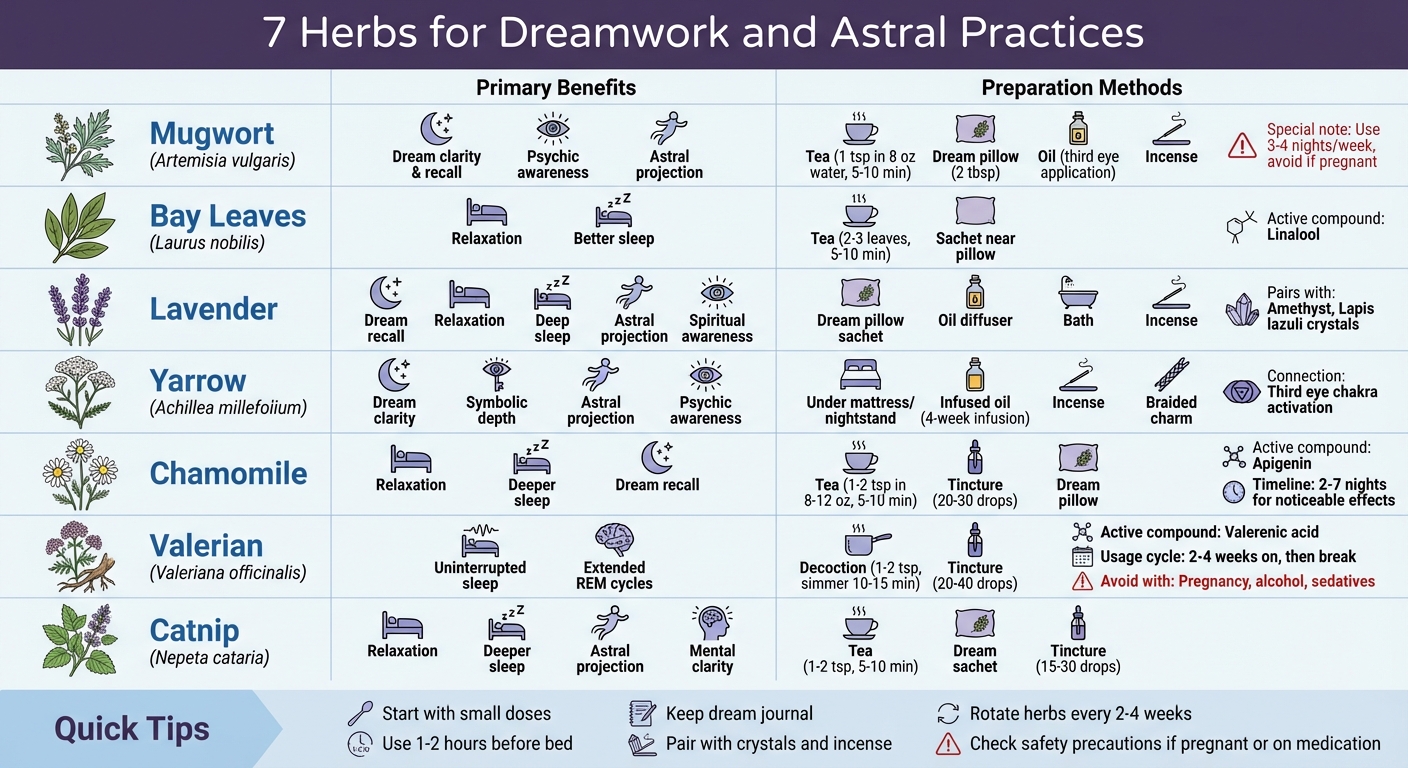
Dreamwork and astral practices have long used herbs to deepen sleep experiences, improve dream recall, and support spiritual exploration. These plants, often called oneirogens, are prepared as teas, oils, incense, or dream pillows to enhance the connection between the conscious and subconscious. Here's a quick look at seven key herbs and their uses:
- Mugwort: Boosts dream clarity, recall, and supports astral projection. Often used as tea, pillow sachets, or oil.
- Bay Leaves: Promotes relaxation and restful sleep; can be brewed as tea or placed near your pillow.
- Lavender: Enhances relaxation, dream recall, and spiritual awareness. Commonly used in sachets, oils, or incense.
- Yarrow: Improves dream clarity and symbolic depth; supports psychic awareness and astral work.
- Chamomile: Calms the nervous system, aiding deeper sleep and dream recall. Often consumed as tea.
- Valerian: Encourages uninterrupted sleep, supporting REM cycles essential for dreaming. Best used as a decoction or tincture.
- Catnip: Eases tension for restful sleep and helps maintain mental clarity during astral practices.
Quick Tips:
- Use teas, tinctures, or dream sachets to incorporate these herbs into your nightly routine.
- Pair with tools like incense, crystals, or dream journals to enhance your practice.
- Always start with small doses and check for safety precautions, especially if pregnant or on medication.
These herbs offer natural ways to explore dreams and spiritual insights. Experiment with different methods to find what works best for your practice.
7 Herbs for Dreamwork: Benefits and Usage Guide
1. Mugwort
Improves Dream Recall and Clarity
Mugwort (Artemisia vulgaris) has long been associated with enhancing dreamwork. Its active compound, thujone, interacts with GABA receptors, making dreams more vivid during REM sleep without causing restlessness or disrupting the natural sleep cycle. Unlike strong sedatives, mugwort helps improve dream quality and recall, giving practitioners a deeper connection to their dream state.
The plant's volatile oils, which make up 0.1%–1.4% of its composition, stimulate the olfactory system, further strengthening the ability to remember dreams. As Sacred Plant Co puts it:
The herb doesn't create visions from nothing - it amplifies and clarifies the dreamwork your unconscious mind is already doing.
Many users report that mugwort's effects on dream recall are particularly potent during the full moon, while the new moon is better suited for introspection and shadow work. Beyond enhancing dream clarity, mugwort is also valued for its ability to support astral projection and heighten psychic awareness.
Supports Astral Projection and Psychic Awareness
Known as a "visionary herb", mugwort is believed to clear mental fog and sharpen intuition. Its connection to lunar energy encourages practitioners to notice subtle spiritual signs and symbols that might otherwise go unnoticed. Original Botanica describes its effects as follows:
Mugwort awakens the mind's inner senses. Its lunar energy supports deep perception, helping practitioners understand subtle signs, symbols, and spiritual impressions.
Often linked to Artemis, the goddess of the moon, mugwort is thought to enhance spiritual perception and awareness. However, because it can leave one feeling energetically heightened, it's recommended to conclude rituals with grounding practices, like rinsing your hands in cool water or sitting in silence, to avoid spiritual exhaustion.
Common Preparation and Usage Methods
One popular way to use mugwort is by preparing a dream tea. Simply steep 1 teaspoon of dried mugwort in 8 ounces of boiling water for 5–10 minutes. Drink it 30–60 minutes before bed while focusing on a specific intention for your dreams. For those who prefer a gentler method, try creating a dream pillow. Fill a small muslin bag with 2 tablespoons of dried mugwort and 1 tablespoon of lavender, then tuck it inside your pillowcase. The aroma will subtly influence your dream state throughout the night.
Another option is to apply mugwort-infused oil to your third eye (the center of your forehead) before meditation or sleep to enhance intuitive flow. For smoke cleansing, burn dried mugwort bundles or loose leaves on charcoal discs to purify your space before engaging in astral work. To avoid building tolerance, limit mugwort use to 3–4 nights per week.
Important safety tip: Mugwort should not be used by individuals who are pregnant or nursing, as it may stimulate menstruation.
These diverse methods showcase the herb’s adaptability in dreamwork and spiritual practices, making it a valuable tool for connecting with deeper states of consciousness.
sbb-itb-a2327d8
2. Bay Leaves
Supports Relaxation and Better Sleep
Bay leaves (Laurus nobilis) are more than just a kitchen staple - they can help ease you into a restful night. These leaves contain linalool, a natural compound often used in aromatherapy for its ability to lower cortisol levels and ease anxiety. This makes it easier to relax and drift off to sleep.
To enjoy the calming effects of bay leaves, you can brew a simple tea by steeping 2–3 dried leaves in hot water for 5–10 minutes. Prefer aromatherapy? Crush a few bay leaves and place them in a sachet near your pillow to enjoy their gentle, soothing scent as you sleep. Whether sipped or inhaled, bay leaves can help create a peaceful bedtime routine.
3. Lavender
Boosts Dream Recall and Clarity
Lavender stands out as a herb that not only aids relaxation but also sharpens dream recall. Its scent works as a sensory anchor, activating parts of the brain tied to memory and emotion. This connection helps signal your subconscious to focus on dreams throughout the night.
Using lavender is simple - just place dried lavender in a small pouch under your pillow. This passive method encourages dream recall without any extra effort. For an added boost, pair lavender with mugwort or chamomile to target different aspects of dreamwork. You can also inhale its soothing aroma while setting a specific dream intention before bed, strengthening the link between the scent and your goal of clearer, more vivid dreams.
Encourages Relaxation and Deep Sleep
Lavender is well-known for its calming effects, making it perfect for promoting deep, restful sleep. Unlike stimulating substances, it’s free of caffeine and safe to use in the evening. This calming quality helps you reach the relaxed state ideal for dreamwork and vivid dreaming. Lavender easily fits into your nightly routine, complementing your dream-focused practices without any disruption.
Enhances Astral Projection and Spiritual Awareness
Lavender also plays a role in supporting astral exploration and meditative practices. Its calming properties help you reach the deep relaxation necessary for astral projection, where the astral body separates from the physical form. You can use lavender oil in a diffuser or burner to scent your space before meditation, or add a few drops to a warm bath to prepare yourself mentally. If you enjoy incense, burning lavender before meditation is another option - just ensure it’s extinguished before you begin.
For those looking to deepen their spiritual practices, lavender pairs well with crystals like amethyst or lapis lazuli. Together, they can enhance your spiritual awareness and create an environment conducive to inner exploration.
4. Yarrow
Improves Dream Recall and Clarity
Yarrow has long been associated with enhancing dreams, offering clarity and symbolic depth. By activating the third eye chakra, it sharpens your ability to recall dreams and interpret their imagery. The ancient Greeks even practiced rhapsodomancy - a form of divination using yarrow stalks - highlighting its historical link to prophecy. Many believe that placing dried yarrow under your mattress or on your nightstand can invite moments of insight and even prophetic visions.
"Yarrow also holds profound sway over the dreamscape, acting as a bridge between our waking world and the enigmatic realm of slumber." – Davezilla, Coventry Products
This connection to dream symbolism makes yarrow an excellent tool for preparing the mind for deeper astral exploration.
Supports Astral Projection and Psychic Awareness
Yarrow is celebrated for its ability to thin the veil between the physical and spiritual worlds, making it easier to align your consciousness with higher energies. This heightened awareness can enhance your ability to receive psychic impressions and spiritual guidance, which is particularly useful during astral projection.
To make the most of these qualities, try creating a yarrow-infused oil. Fill a clean jar two-thirds full with dried yarrow flowers, then top it off with olive oil. Let the mixture sit for four weeks, shaking it daily. Once ready, apply a small amount to your third eye before meditating or sleeping to help clear energetic blockages. Burning yarrow as incense during tarot readings or other divination practices can also deepen your intuitive focus. For added protection during spiritual journeys, braid yarrow with red thread and charge it under a full moon to create a protective charm.
Common Preparation and Usage Methods
There are several ways to incorporate yarrow into your spiritual practice. You can combine it with herbs like mugwort and lavender in a small sachet and place it inside your pillowcase to encourage lucid dreaming. Burning yarrow as a smudging herb before bedtime can help prepare your mind for vivid dreams, while applying yarrow-infused oil to your third eye promotes energetic alignment. Known botanically as Achillea millefolium, yarrow’s history of use for healing and protection underscores its deep spiritual significance.
5. Chamomile
Promotes Relaxation and Deeper Sleep
Chamomile is known for its calming effects on the nervous system, helping you relax and encouraging vivid dreams. Its active compound, apigenin, interacts with benzodiazepine receptors to ease tension without causing heavy sedation. This makes it an excellent choice if an overactive mind or nervous energy is keeping you awake.
"Chamomile functions as a mild dream herb that works through relaxation and ease rather than direct dream stimulation." – Sacred Plant Co
By soothing the mind and body, chamomile helps you fall asleep naturally, paving the way for the REM stage of sleep. This is the phase where the most intricate and memorable dreams occur.
Improves Dream Recall and Clarity
Chamomile doesn’t directly stimulate dreams like some herbs but instead creates the ideal conditions for deeper, restful sleep. When you reach deep relaxation, your body cycles more effectively through REM sleep - the stage crucial for emotional processing and memory consolidation. In July 2023, Mountain Rose Herbs shared a "Dream Tea Recipe" that included 2 parts organic chamomile flowers, blended with mugwort and rosemary, to enhance dream recall during REM sleep. Regular use, typically over 2 to 7 nights, often leads to noticeable improvements in dream clarity and recall.
Common Preparation and Usage Methods
Chamomile’s versatility makes it easy to incorporate into your bedtime routine. Here are a few simple ways to use it:
- Tea infusion: Steep 1–2 teaspoons of chamomile in 8–12 oz of boiling water for 5–10 minutes. Drink it 1–2 hours before bed.
- Tincture: For faster effects, take 20–30 drops of diluted chamomile tincture.
- Dream pillow: Fill a small fabric pouch with dried chamomile and place it under your pillow to enjoy its calming aroma throughout the night.
When buying chamomile, choose flowers with vibrant centers and a fresh, apple-like scent, as these indicate potent essential oils for sleep.
6. Valerian
Encourages Relaxation and Better Sleep
Valerian root (Valeriana officinalis) is known for supporting deep, uninterrupted sleep, which is crucial for experiencing vivid dreams. Its active component, valerenic acid, interacts with GABA receptors in the brain to ease tension and shorten the time it takes to fall asleep. A review in the American Journal of Medicine highlighted that valerian enhances perceived sleep quality without causing major side effects.
"Valerian root creates the ideal physiological foundation for vivid dreaming by supporting deep, uninterrupted sleep." – Sacred Plant Co
Unlike some pharmaceutical sleep aids that may suppress REM sleep, valerian is thought to help extend this important sleep stage. By doing so, it not only boosts overall sleep quality but also enhances the effects of other dream-focused herbs, paving the way for more intricate and vivid dream experiences.
How to Prepare and Use Valerian
Valerian root, being dense, is best prepared as a decoction. Simmer 1–2 teaspoons of the dried root in 10–12 ounces of water for 10–15 minutes. Alternatively, you can use a tincture - 20–40 drops diluted in water, taken 1–2 hours before bedtime.
High-quality valerian root is recognizable by its strong, earthy smell and golden-brown color, which signal the presence of intact valerenic acids. Many practitioners recommend cycling valerian use, typically taking it for 2–4 weeks followed by a short break to prevent diminishing effects. For dreamwork, using it consistently over 3–7 nights may help maximize its benefits.
Safety Tips: Avoid valerian if you’re pregnant or consuming alcohol, benzodiazepines, or other sedatives. For added relaxation, combine valerian with herbs like passionflower or chamomile to ease pre-sleep anxiety and stress, which can interfere with dream recall.
Next, discover another herb that complements valerian in dreamwork and astral exploration.
7. Catnip
Promotes Relaxation and Deeper Sleep
Catnip (Nepeta cataria) is known for its calming properties, making it helpful for quieting a busy mind and easing tension before bed. By soothing the nervous system, catnip prepares you for a state of relaxation that supports vivid and memorable dreams. It also encourages a restful state that may promote deeper sleep and extended REM cycles, which are essential for dream intensity and recall.
Supports Astral Projection and Psychic Awareness
Astral projection requires a unique state of consciousness - somewhere between sleep and wakefulness. Catnip aids in achieving this delicate balance by promoting relaxation while maintaining a level of mental clarity. Its subtle aroma can further enhance focus and openness, making it easier to connect with astral experiences. Whether used in dream pillows or as a pre-sleep infusion, catnip can complement other herbs in your dreamwork routine by encouraging a receptive state for astral exploration.
Common Preparation and Usage Methods
Catnip is versatile and easy to incorporate into your practices. You can steep 1–2 teaspoons of dried catnip in 8 ounces of hot water for 5–10 minutes to create a soothing tea. For a more aromatic approach, place a sachet of dried catnip in your pillowcase to enjoy its calming scent while you sleep. Another option is to take 15–30 drops of catnip tincture diluted in water about 30–60 minutes before bedtime. These simple methods make catnip an excellent addition to your dream-enhancing routine.
5 Herbs that help with Lucid Dreaming:
How to Use Herbs in Your Practice
Once you've familiarized yourself with individual herb profiles, you can start incorporating them into your nightly dreamwork rituals. One popular method is using tea infusions. To prepare, steep 1–2 teaspoons of dried herbs in 8–12 ounces of boiling water for 5–10 minutes. Drink this herbal tea 1–2 hours before bedtime for the best results. For roots like valerian, a decoction works better. Simmer the root in 10–12 ounces of water for 10–15 minutes to extract its active components. If you need a more concentrated option, tinctures are a great choice. Simply dilute 20–30 drops in water for quick absorption.
For something more hands-off, consider dream sachets. Fill a small fabric pouch with dried herbs like mugwort, lavender, or chamomile, and place it under or inside your pillowcase. As the herbs release their volatile oils throughout the night, they engage your sense of smell, which is closely tied to memory and emotions. You can also burn herbs as incense to cleanse your space. Alternatively, try adding herbs like blue lotus or lavender to a warm herbal bath before bed to ease anxiety and prepare your mind and body for dreamwork.
Safety is key. Start with small doses to see how your body reacts, especially if you have allergies to plants in the Asteraceae family, like ragweed or daisies. Pregnant individuals should avoid herbs like mugwort, valerian, and passion flower, as they may stimulate the uterus. Additionally, if you're taking medications like sedatives, blood thinners (e.g., warfarin), or MAO inhibitors, consult your healthcare provider before using these herbs to avoid potential interactions.
To enhance your dreamwork, you can pair your herbal practices with tools like dreamcatchers to filter energy or apply herbal-infused oils to your pulse points before sleep. Products from Rivendell Spiritual Gifts, such as incense and oils, can complement your rituals perfectly. Burning specific incense blends can signal the transition into the dream state, while placing herbs in bowls on a dream altar - alongside crystals like moonstone or obsidian - can enrich your practice.
Keeping a dream journal is another essential step. Documenting your dreams can improve recall and amplify the effects of the herbs. Before going to bed, set a clear intention, such as affirming your protection during dream travel or your goal to return with new insights. Stick with your chosen method consistently for 7–14 days to track its impact, and rotate the herbs every 2–4 weeks to maintain their effectiveness.
Conclusion
Herbs for dreamwork offer a natural way to enhance vivid dreams, improve recall, and explore deeper spiritual insights. Whether your goal is lucid dreaming, emotional healing, or connecting more deeply with your subconscious, these seven botanicals can support your journey.
The key to unlocking their potential lies in patience and experimentation. Try different approaches - like teas, tinctures, sachets, or baths - and find what works best for you. For an added sensory layer, consider incorporating incense for meditation, oils, or crystals, such as those available from Rivendell Spiritual Gifts. Don’t forget to keep a dream journal nearby to record your experiences before they fade. As Vivianna Severance, Founder of Wild Raven's Nest, wisely advises:
Expectation is the killer of dreams and intuition. Your goal is to continue your practice... allowing what wants to come through.
Mugwort, lavender, valerian, and the others each offer distinct benefits to enrich your practice. By weaving these herbal allies into your nightly rituals, you open the door to deeper self-discovery and spiritual connection. Start your journey tonight and see where your dreams take you.
FAQs
Which herb is best for lucid dreaming?
Mugwort (Artemisia vulgaris) has earned a reputation as a go-to herb for those seeking lucid dreams. Known for its long-standing use, it’s celebrated for helping make dreams more vivid and easier to remember. This has made it a popular choice for dream-related practices and exploring astral experiences.
Can I combine multiple dream herbs safely?
Yes, combining dream herbs can be safe if approached with care and proper understanding. Make sure to research each herb thoroughly, paying attention to its effects and any possible interactions. Start with small doses to see how your body reacts before considering adjustments. Always listen to your body and proceed cautiously.
How do I avoid herb tolerance over time?
To keep herbs effective during dreamwork and astral practices, it's a good idea to rotate or cycle through different options. Switching between herbs like mugwort, blue lotus, or lavender can help prevent your body from building a tolerance. You might also try blending herbs or tweaking their timing and dosage to maintain their benefits. These approaches can help ensure your practice stays impactful without your body becoming too used to any single herb.