
Tarot is not about predicting the future - it’s a tool for self-reflection and personal growth. By interpreting the symbolic imagery of 78 cards, tarot helps you understand your emotions, beliefs, and life challenges. It acts as a mirror to your inner world, guiding you toward clarity and self-awareness.
Key Takeaways:
- Reflection Over Prediction: Tarot reveals what you already know but may not fully realize.
- Personal Growth: It supports self-awareness, reduces stress, and helps you feel more in control of your life.
- Practical Use: Combine tarot with mindfulness, journaling, or tarot spreads for self-discovery for deeper insights.
- Symbolic Framework: Major Arcana cards represent universal life themes, while Minor Arcana cards focus on daily situations.
- Ethical Practice: Tarot is a reflective tool, not a replacement for professional advice.
Tarot’s real strength lies in its ability to help you explore your thoughts and emotions, providing a structured way to understand yourself better.
How Tarot Supports Self-Reflection and Insight
Tarot as a Projective Tool
Tarot works much like a projective test, encouraging you to project your thoughts, emotions, and beliefs onto its archetypal imagery. Unlike abstract shapes used in traditional projective tests, tarot’s use of symbolic and relatable human experiences makes the process feel more intuitive and grounded.
"Tarot can act as a symbolic mirror, offering a structured way to explore inner narratives and personal meaning." - Jourdan Tymkow, Psychologist
The visual elements of tarot - its symbols, colors, and mythic figures - have a unique way of bypassing the rational mind's defenses. Instead of overanalyzing or rationalizing your feelings, you’re drawn into the imagery, which often leads to more honest and spontaneous reactions. Psychologist Kerykeion explains this dynamic:
"The cards reflect our emotional state, hidden beliefs, strengths, and blind spots."
One practical method to engage with tarot study is the "Mirror Spread", where three cards are laid out to represent your conscious view of a situation, what you might be repressing, and the bridge connecting the two. This simple layout often brings unexpected insights to light.
This ability to reflect on and restructure personal narratives sets the stage for deeper exploration, which we’ll dive into next.
Storytelling and Cognitive Reframing Through Tarot
Drawing a tarot card disrupts habitual thought patterns, encouraging deliberate reflection. This concept, often referred to as "productive constraint", focuses your attention and guides you toward meaningful interpretations.
This process parallels a concept from narrative therapy called externalization. By projecting your challenges or emotions onto a card, you take abstract feelings and shape them into something tangible. This structured approach often leads to deeper insights than passive reflection alone. Tarot essentially transforms your inner experiences into a clear story - with characters, settings, and possible resolutions - making it easier to understand your situation.
"The role of a tarot reader is not to define each card but to guide the seeker to self-discovery using each card as a tool for reflection." - Michael Abraham-Fiallos
By turning vague emotions into structured narratives, tarot becomes a tool for personal insight and growth.
Archetypes and Symbolism in Personal Growth
Tarot’s imagery also taps into universal archetypes, offering guidance for personal development. The Major Arcana’s 22 cards each correspond to a human archetype - patterns of experience that Carl Jung believed exist in the collective unconscious. For instance, The Magician reflects our outward persona, The Devil represents internal conflicts, and The World symbolizes integration and completeness.
"Until you make the unconscious conscious, it will direct your life and you will call it fate." - Carl Jung
This connection makes tarot particularly useful for shadow work - the process of identifying and integrating the parts of yourself that you might prefer to ignore. If a card stirs discomfort, that reaction often points to areas of your unconscious worth exploring.
Interestingly, cognitive science supports this idea. The act of shuffling and reflecting on tarot cards appears to activate the brain’s self-reflection centers - the same areas engaged during meditation. By recognizing these archetypes, you can integrate hidden aspects of yourself, driving inner transformation and growth.
sbb-itb-a2327d8
Tarot for Personal Transformation with Janis King
Tarot in Counseling and Personal Development
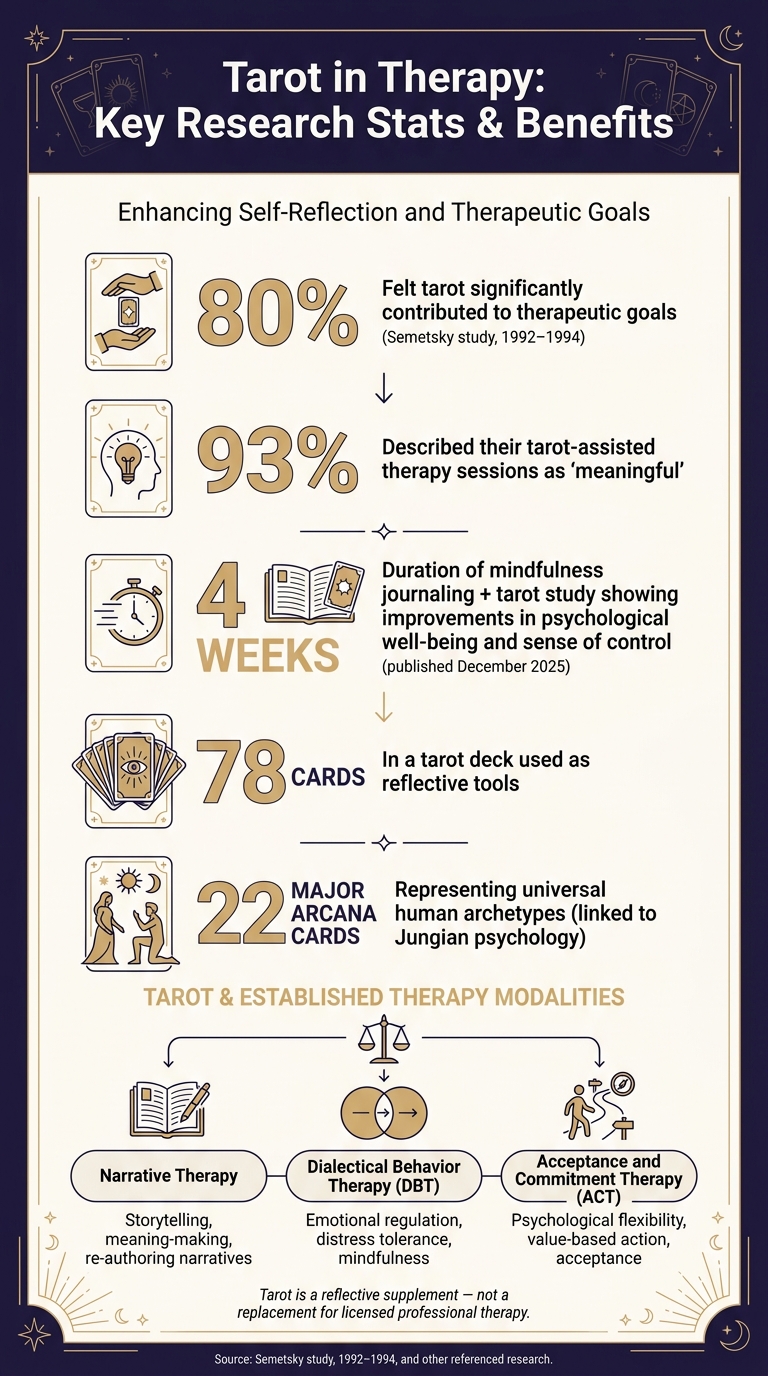
Tarot in Therapy: Key Research Stats & Benefits
Tarot as a Supplement in Counseling and Psychotherapy
Tarot has found its way into counseling and psychotherapy as a tool to complement traditional therapeutic methods. It helps clients access emotions or thoughts they might struggle to express. Therapists have paired tarot with approaches like Narrative Therapy, Dialectical Behavior Therapy (DBT), and Acceptance and Commitment Therapy (ACT). The visual and symbolic nature of tarot cards engages both emotional and visual processing, making it easier for clients to explore difficult topics.
From 1992 to 1994, a study led by researcher Inna Semetsky under California's Behavioral Board Science Examiners highlighted tarot's therapeutic potential. The findings revealed that tarot imagery helped participants connect past traumas with present challenges. Notably, 80% of participants felt tarot significantly contributed to their therapeutic goals, and about 93% described their sessions as "meaningful". These results align with broader aims in therapy, such as fostering self-awareness and improving emotional resilience.
"Tarot is about meaning-making, which is at the heart of psychodynamic psychotherapy. The cards serve as mirrors, sparking insight and opening space for personal storytelling." - Dr. Kristen Long, Licensed Psychoanalyst and NYU Instructor
Dr. Kristen Long, who teaches at New York University (NYU), incorporates tarot into graduate-level clinical courses. She emphasizes its value in psychodynamic psychotherapy as a tool for reflection and meaning-making. Beyond clinical settings, tarot also plays a growing role in self-help and coaching practices.
Tarot in Self-Help and Coaching
Outside formal therapy, tarot has become a popular tool in personal development workshops, journaling, and coaching. The focus in these settings shifts from predictive questions like "What will happen to me?" to reflective ones such as "What am I not allowing myself to see?" or "What story am I telling myself that might not be accurate?" This shift reframes tarot as a structured tool for self-exploration, promoting cognitive reframing and personal storytelling. Some practitioners even use frameworks like Gibbs' Reflective Cycle to guide card interpretation and subsequent reflections.
A study published in December 2025 explored the combination of tarot card readings with mindfulness journaling. Over four weeks, participants reported improvements in psychological well-being and a stronger sense of control.
"Tarot is the most successful projective psychological instrument ever devised by people who had absolutely no intention of devising a projective psychological instrument." - Alan Jones, PhD FRSA
This self-guided approach to growth underscores tarot's potential as a reflective tool, though ethical considerations remain critical.
Ethical Use and Professional Boundaries
While tarot can be a valuable supplement, it should never replace evidence-based treatments. Clients must understand upfront that tarot serves as a reflective aid rather than a supernatural predictive tool. A potential risk is the misinterpretation of spiritual experiences, where mental health crises could be mistaken for spiritual awakenings.
As Crystal Venegas, a Licensed Marriage and Family Therapist, explains:
"Tarot is not about predicting the future. It's a reflective tool that offers imagery, symbolism, and intuitive prompts that often tap into what's already stirring beneath the surface." - Crystal Venegas
When used responsibly - with clear boundaries and informed consent - tarot can deepen self-awareness and support personal growth without interfering with conventional therapeutic methods.
Combining Tarot with Other Wellness Tools
Tarot doesn’t have to stand alone. Pairing it with complementary tools like crystals, aromatherapy, and intentional lighting can make the experience more reflective and purposeful. These additions can help create a grounded and meaningful practice.
Setting Intentions with Tarot and Crystals
Both tarot and crystals rely on symbolism and intention, making them a natural pair. When used together, they can deepen insights gained during a reading. For instance:
- Clear Quartz: Place it near the top of a tarot spread to enhance clarity.
- Black Tourmaline: Position it at the base of the spread to help ground insights into actionable steps.
- Rose Quartz: Align it with heart-related cards to soften challenging messages.
- Amethyst: Use it to strengthen psychic reception and connect to higher guidance.
For beginners, starting with a small set - Clear Quartz, Amethyst, Rose Quartz, and Black Tourmaline - can address a variety of energetic needs. Some practitioners also “charge” their tarot decks by placing crystals on top overnight or keep Selenite nearby to clear lingering energy between sessions. Rivendell Spiritual Gifts offers a wide selection of crystals and tarot decks to support this combined practice.
To take this further, you can enhance the experience by engaging your sense of smell.
Using Aromatherapy and Incense to Support Focus
Scent has a powerful influence on emotions and mental clarity. Specific aromas can stimulate the limbic system, which plays a role in intuition, emotional release, and focus during a tarot reading. As Mary K. Greer notes:
"By linking certain scents to the energy and meanings of different tarot cards, we can enhance our connection to the cards." - Mary K. Greer
Each scent serves a unique purpose:
- Rosemary and Peppermint: Sharpen focus at the start of a session.
- Lavender and Chamomile: Promote emotional balance.
- Frankincense, Sandalwood, and Mugwort: Ground energy and enhance intuitive channels.
Rivendell Spiritual Gifts offers incense and essential oils to help create an inviting atmosphere for your readings. Pairing these scents with thoughtful lighting can create an even deeper connection.
Salt Lamps and Lighting for Tarot Sessions
Lighting can subtly shape the mood of your tarot space. Soft, warm lighting - like the amber glow from a Himalayan salt lamp - encourages slower, more deliberate thinking. As tarot researcher Alan Jones, PhD, explains:
"What interrupts System 1 is novelty, incongruity, or deliberate effort... System 2: slow, deliberate, effortful thinking that can actually examine assumptions... It requires a prompt. A tarot reading [in a candlelit room], whatever else it is, is an extremely effective prompt." - Alan Jones, PhD
In contrast, harsh overhead lighting can keep the mind in a task-oriented mode. Softer options like candles or salt lamps encourage reflection and promote a sense of calm. Benebell Wen points out that light therapy and environmental awareness can even stimulate serotonin production, supporting emotional balance and self-healing. Keeping a journal to track which lighting setups work best for your sessions can further refine your practice.
Rivendell Spiritual Gifts also offers Himalayan salt lamps to help you create the ideal ambiance for your tarot readings.
Research Gaps, Risks, and Future Directions
Current Research Limitations and Gaps
When it comes to understanding tarot's effectiveness, the research is still in its infancy. Most of the studies rely heavily on qualitative methods, like personal journals and self-reported experiences. This makes it difficult to draw solid conclusions. One significant challenge is the Barnum effect, demonstrated in a 1948 experiment where participants rated vague, universally applicable statements as highly personal. This suggests that general observations in tarot readings might be mistaken for deep personal insights. Tarot also faces similar criticisms as tools like the Rorschach inkblot test, which are often seen as conversation starters rather than reliable measurement tools.
Risks and Ethical Concerns in Tarot Practice
One of the biggest risks in tarot practice is over-reliance. When people use tarot for making major life decisions instead of as a tool for reflection, it can lead to apophenia - finding meaning in unrelated details. Another concern is the potential for "reverse tarot", where readings may fuel negative thought patterns instead of offering constructive insights.
Ethical practitioners emphasize the importance of understanding tarot's role:
"The tarot is not issuing instructions from on high. It is prompting reflection. The difference matters enormously, both psychologically and ethically." - Alan Jones, PhD
Tarot is not a substitute for professional advice or therapy. It should never replace licensed medical, psychological, or legal guidance. A responsible tarot reader knows when to direct someone toward professional support and communicates this clearly.
Directions for Future Research
Future research could benefit from exploring tarot in conjunction with evidence-based practices. For example, studies on expressive disclosure - a method where individuals write about emotionally significant experiences for 15–20 minutes over several days - have shown improvements in mood and immune function. Combining tarot prompts for mindfulness with this kind of structured journaling could open up new possibilities for therapeutic applications.
Dr. Yiu Kwong Au-Yeung highlights the importance of expanding research:
"The effectiveness of tarot as a psychological tool warrants future research into its potential therapeutic applications, cross-cultural adaptations, and role in the twentieth century meaning-making practices."
Cross-cultural studies are another promising avenue, especially as tarot evolves from a divination tool to a framework for self-reflection in modern cities like Hong Kong and London. Researcher Tomasz Fiedoruk offers a thought-provoking perspective on the focus of future studies:
"The right question is not 'is it accurate?' but 'is it useful?'"
Conclusion: Using Tarot for Personal Transformation
Tarot serves as a reflective tool, offering a way to explore your inner world. Its strength lies in its ability to reveal what you already know but may not yet fully understand. As Alan Jones, PhD, explains, "tarot reveals what is already known." When approached with this mindset, the 78 cards become a powerful tool for self-reflection.
Reframing the question from "What will happen?" to "What am I not seeing?" shifts tarot's role from a predictive device to a mirror that highlights unconscious patterns. This change encourages deeper self-inquiry, fostering a practice that brings clarity and actionable insights. While structured reflection methods can enhance this process, they don't always require rigid frameworks to be effective.
Incorporating environmental elements like crystals, incense, or salt lamps can further enrich the reflective experience. These tools help create a calming atmosphere that encourages introspection. For instance, Rivendell Spiritual Gifts offers a range of items, including tarot cards, crystals, and incense, making it easy to build a cohesive practice from one place.
When used thoughtfully, tarot can complement personal growth efforts. It's not a replacement for therapy or professional guidance, but it can deepen self-awareness. As Tomasz Fiedoruk puts it:
"The cards do not know anything about you. But you know things about yourself that you have not yet put into words, and the practice of sitting with a card... is one of the most direct paths from vague self-awareness to genuine self-knowledge."
This perspective highlights tarot's potential as a meaningful addition to a wellness routine, encouraging a journey toward greater self-understanding.
FAQs
How do I use tarot for self-reflection instead of prediction?
To use tarot as a tool for self-reflection, shift your focus inward rather than looking for external solutions. Start by drawing a card and taking a moment to study its imagery. Before reaching for a guidebook, pay attention to how the card makes you feel or what thoughts it stirs. Let your intuition guide you.
Ask yourself open-ended questions like: What part of me needs nurturing right now? or What truth am I hesitant to face? Writing down your thoughts in a journal can help you translate these reflections into deeper self-awareness and personal growth.
What’s a simple tarot spread for personal growth?
A five-card Personal Growth Spread can be a helpful tool to dive deeper into self-reflection. Here's how it works: lay out five cards to examine your current challenges, the lessons you need to learn, your strengths, any potential obstacles, and the best course of action to take moving forward.
If you're looking for something less complex, a three-card spread for shadow work might be a better fit. This approach focuses on uncovering what you're repressing, understanding why you're holding it back, and discovering how to integrate that insight into your life in a meaningful way.
How can I combine tarot with journaling or mindfulness?
Combining tarot with journaling transforms the cards into a powerful avenue for self-reflection. The process begins with setting a simple ritual: shuffle your deck, take a few deep breaths, draw a card, and then jot down your thoughts. You can take a more structured approach, like using Gibbs' reflective cycle to analyze the card’s meaning step-by-step. Or, you might prefer free-writing, letting your subconscious guide you as you explore what the card evokes. Either way, this practice promotes mindfulness and encourages a deeper connection with yourself.