

Sunlight charging is a simple yet effective way to refresh your crystals, boosting their energy and clearing away any stagnation. By exposing crystals to sunlight, you can reset their vibrational frequencies and enhance their natural properties. Here's what you need to know:
- Why Sunlight Works: Sunlight provides infrared heat, visible light, and UV radiation, which interact with a crystal’s structure to recharge its energy. Quartz, for example, benefits from the piezoelectric effect, amplifying its vibrations.
- Best Crystals for Sunlight: Durable stones like clear quartz, carnelian, and tiger’s eye can handle 2–4 hours of sunlight. Delicate crystals like amethyst or rose quartz should be charged briefly (under 30 minutes) to avoid fading or damage.
- Timing Matters: Morning sunlight (sunrise to 10:00 AM) is gentle and ideal for most crystals. Midday sunlight is stronger but can harm light-sensitive stones.
- Safety Tips: Avoid leaving clear crystals in direct sunlight unattended, as they can focus light and cause fires. Use natural surfaces like soil or wood, and steer clear of heat-retaining materials like metal.
To charge your crystals effectively, cleanse them first, set a clear intention, and choose the right conditions for their needs. This practice not only revitalizes your stones but also helps align their energy with your goals.
How Sunlight Charging Works
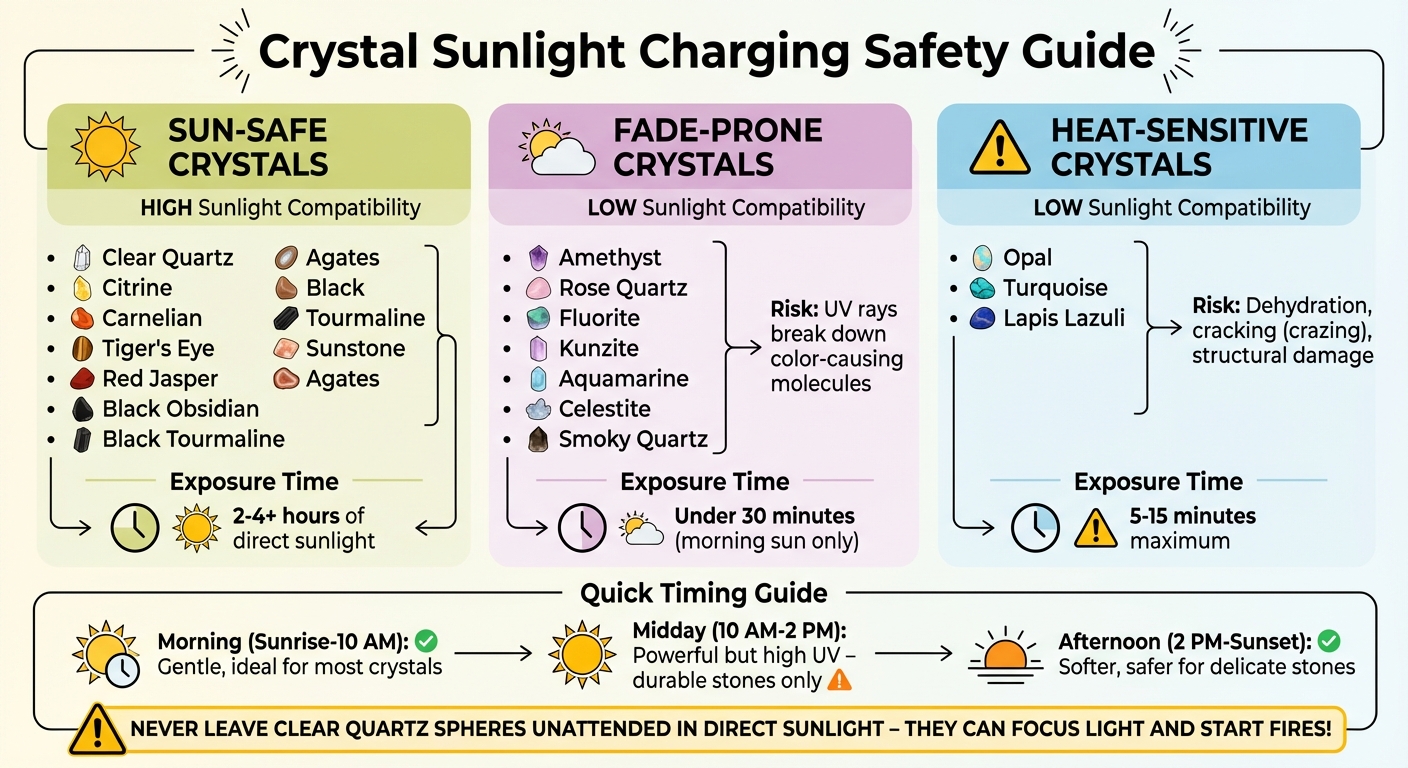
Crystal Sunlight Charging Safety Guide: Which Crystals Are Sun-Safe vs Sensitive
Sunlight recharges crystals by using infrared, visible, and ultraviolet radiation to reset their vibrational frequency and clear out stagnant energy. When crystals absorb sunlight, they experience a quick energy boost that impacts both their physical and energetic properties. As sunlight warms the crystal, its internal structure slightly expands, causing minimal stress within the lattice. This process generates a small electric charge, which fine-tunes the crystal’s physical structure while enhancing its energetic qualities.
The color of a crystal plays a key role in determining which wavelengths it absorbs, making it important to choose charging methods that align with its properties. For instance, red stones like carnelian absorb blue and green wavelengths, while clear quartz captures a wider range of light. However, prolonged exposure to UV radiation can break down the chemical bonds in chromophores (the molecules responsible for color), causing some crystals to fade over time.
The Role of Solar Energy in Crystal Work
In spiritual practices, sunlight is often associated with "masculine" energy - dynamic, radiant, and outward-focused. Many practitioners use sunlight to charge crystals for intentions linked to vitality, confidence, motivation, and manifestation. The sun’s heat is thought to infuse minerals with energy that enhances their ability to support healing and empowerment.
Stones like orange and yellow crystals, which are connected to the solar plexus chakra, resonate naturally with solar energy. Sunlight charging is believed to strengthen their ties to creativity, personal power, and self-expression. This method is particularly popular because it works quickly - typically taking only 30 to 60 minutes to recharge a crystal. Compared to slower techniques like earth burial, sunlight offers a faster and more convenient option for clearing and energizing stones.
Which Crystals Are Safe for Sunlight Charging
Some crystals are tough enough to withstand 2 to 4 hours - or even longer - of direct sunlight without damage. These include clear quartz, natural citrine, carnelian, tiger's eye, red jasper, black obsidian, black tourmaline, sunstone, and various agates. Their darker or opaque colors, along with stable chemical structures, make them resistant to fading caused by UV rays.
On the other hand, certain crystals are more delicate and should only be exposed to sunlight briefly - ideally less than 30 minutes in the gentle morning sun. This group includes amethyst, rose quartz, fluorite, kunzite, aquamarine, celestite, smoky quartz, as well as opal, turquoise, and lapis lazuli. For example, UV rays can fade amethyst to a pale gray or lavender, while opals, which contain 3% to 21% water, risk cracking (a condition called "crazing") when exposed to heat for too long.
By understanding these reactions, you can better decide which crystals are suitable for prolonged sunlight exposure.
| Crystal Category | Examples | Sunlight Compatibility |
|---|---|---|
| Sun-Safe | Clear Quartz, Citrine, Carnelian, Tiger's Eye, Red Jasper, Black Obsidian, Black Tourmaline, Sunstone, Agates | High; can handle 2–4+ hours of direct sunlight |
| Fade-Prone | Amethyst, Rose Quartz, Fluorite, Kunzite, Aquamarine, Celestite, Smoky Quartz | Low; UV rays can break down color-causing molecules |
| Heat-Sensitive | Opal, Turquoise, Lapis Lazuli | Low; risk of dehydration, cracking (crazing), or damage |
For semi-sensitive stones, charging them indoors on a windowsill can be a safer alternative. Standard window glass blocks most UV-B and some UV-A rays, reducing the risk of fading or damage. However, this method may require 50% to 100% more time to achieve the same effect as direct sunlight. Additionally, be cautious with clear quartz spheres in direct sunlight, as they can act as magnifying glasses and potentially ignite flammable surfaces.
sbb-itb-a2327d8
Step-by-Step Sunlight Charging Process
Preparing Your Crystals Before Charging
Start by cleaning your crystals with water and mild soap to remove dirt or debris, ensuring sunlight can penetrate effectively. However, if you’re working with porous or metal-based stones like Selenite, Malachite, Lepidolite, or Pyrite, skip the water - these can dissolve or rust when exposed to moisture [5,9].
Next, clear out any lingering or stagnant energy by performing an energetic cleanse. This step resets the crystal, preparing it for new intentions. You can pass the crystal through the smoke of Palo Santo, White Sage, or incense while focusing on releasing old energy [5,9]. If you prefer a sound-based method, use a singing bowl, tuning fork, or bell near the crystal for 30–60 seconds to clear its energy without touching it. A quicker alternative involves holding the crystal and exhaling forcefully onto it while visualizing the release of unwanted vibrations.
"Cleansing is the process of eliminating all the energy that the crystal has received, both negative and positive. It turns the crystal into a clean slate."
– Rivendell Shop
After cleansing, check if your crystal is safe for sunlight exposure by referring to compatibility guidelines. Place your crystals on natural surfaces like soil, wood, or stone to encourage a balanced energy exchange [4,8]. Avoid metal surfaces - they can overheat and damage your crystals.
With your crystals prepped and ready, you can move on to infusing them with focused energy.
Setting Your Intentions
Before charging, take a moment to connect with each crystal by holding it in your hand [5,6]. Be specific about your intention - focus on one purpose at a time to avoid mixed signals.
Close your eyes and visualize a bright white or golden light filling the crystal, clearing away any old energy and replacing it with fresh solar energy. Speak your intention aloud or silently, programming the crystal for a specific goal, like boosting vitality or aiding manifestation [6,9].
"Hold each crystal in your hand before placing it in sunlight, clearly stating your intention for how you wish the solar energy to enhance or program the stone."
– Janie Fagan, Lead Writer and Crystal Expert, Coppermoon
Anchor your intention by taking slow, deep breaths, focusing on your goal until you feel a shift in the crystal’s energy [9,10]. When the programming feels complete, express gratitude to the sun for its energy.
With your intentions set, it’s time to choose the best time and conditions for charging.
Timing and Conditions for Charging
Morning sunlight (from sunrise to 10:00 AM) offers a gentle and refreshing energy, making it ideal for most crystals. The lower UV intensity during this time is especially suitable for semi-sensitive stones. Limit exposure to 30–60 minutes for stones like smoky quartz, and allow 2–4 hours for tougher stones like clear quartz or carnelian [1,3,6].
Midday sunlight (10:00 AM–2:00 PM) delivers powerful, activating energy but comes with higher UV levels, which can cause fading or heat damage. Use this window only for the most durable crystals, and never leave clear crystal spheres unattended in direct sunlight - they can act as magnifying lenses and ignite flammable materials [1,4].
Late afternoon sunlight (2:00 PM to sunset) provides a softer, golden glow associated with gratitude and completion. The UV intensity decreases during this time, making it a safer option for more delicate stones [1,6].
Weather and seasonal changes can affect charging times. Light clouds filter 20–40% of solar energy, so you’ll need to extend the charging time by 1–2 hours. On heavily overcast days, aim for 5–7 hours to achieve a full charge. During winter, weaker sunlight means doubling the charging duration, while in summer, reduce exposure by 25–30% to prevent overheating. For a safer approach, place your crystals on a south-facing windowsill. While this filters most UV-B rays, it also requires 50–100% more time than direct outdoor sunlight.
Precautions and Common Mistakes
Crystals That Fade in Sunlight
When it comes to charging crystals, handling them with care is key to preserving their color and energy. Not all crystals can endure direct sunlight. Stones that transmit light are especially prone to UV damage, while opaque ones tend to hold up better. This difference comes down to their chemical makeup - crystals with metal components, like iron, can lose their color permanently and even undergo structural changes when exposed to UV light.
For example, Amethyst can fade from a rich purple to a pale hue after prolonged exposure. Rose Quartz may lose its pink tone, turning white and brittle over time. Celestite, on the other hand, can crack and bleach out in as little as 15 minutes as UV rays break its crystal lattice bonds. Kunzite fades quickly, and Fluorite not only loses its color but also absorbs heat rapidly. Opal, which can contain up to 21% water, is particularly vulnerable - sunlight can dehydrate it, dull its play-of-color, and make it brittle.
"The color changes because of structural damage to the stone because of metals inside the stone reacting to the UV light. So, the color of a crystal changing means the stone's material has changed."
– Eline, Crystal Enthusiast and Educator
Other crystals that are sensitive to sunlight include Ametrine, Apatite, Aquamarine, Aventurine, Beryl, Calcite, Chrysoprase, Citrine (especially heat-treated varieties), Prasiolite, Sapphire, Smoky Quartz, Spirit Quartz, Topaz, and Turquoise. For these stones, limit direct sunlight exposure to just 5–15 minutes. A shaded area or a windowsill with indirect light can be a safer option.
Interestingly, some stones, such as Sodalite, Hackmanite, and Barite, can darken when exposed to sunlight.
Preventing Overexposure and Heat Damage
Sunlight doesn't just cause fading - it can also compromise a crystal's structure. Excessive heat from the sun can weaken the bonds in a crystal's lattice, making it brittle, prone to cracks, or even causing it to shatter. Crystals with high water content, like Opal and Chrysoprase, are particularly at risk of losing moisture, which leads to permanent fragility. If Chrysoprase becomes brittle, gently rehydrate it by patting it with damp cotton wool.
Another concern is that transparent crystals can act like magnifying glasses, focusing sunlight and potentially igniting flammable materials nearby. Clear crystal spheres or faceted clusters should never be left in direct sunlight near curtains, papers, or wooden surfaces.
To avoid heat damage, avoid placing crystals on surfaces that absorb high amounts of heat, like metal or dark pavement. Opt for natural materials such as wood, soil, or stone instead. If a crystal feels hot to the touch, move it to a cooler spot and let it cool naturally. Exposing a hot crystal to cold water can cause thermal shock and lead to cracking.
Storing Crystals After Charging
Proper storage plays a big role in protecting crystals after they’ve been charged. Light-sensitive stones should be kept in cool, dark places to prevent further fading or brittleness. Wooden or glass containers lined with natural fabrics, like silk or cotton, offer excellent protection. It’s also important to keep crystals away from windows, direct sunlight, and electronic devices to avoid energy interference.
For stones that are sensitive to water, adding silica gel packets or anti-tarnish strips to the storage container can help control humidity levels. Before storing, make sure crystals have fully cooled down after sun exposure to avoid trapping residual heat.
"Most crystals that are transparent or semi-transparent should not be exposed to sunlight as they are prone to their colours fading or the crystals cracking with the heat and light exposure."
– Love Amber x Ltd
Products to Support Your Sunlight Charging Practice
Boost your crystal charging routine with tools and accessories designed to amplify and maintain their energy.
Crystals and Accessories for Charging
Selenite is a must-have. It naturally cleanses itself and purifies other crystals nearby. For an added touch, the Mini Selenite LED Lamp ($40.00) combines selenite’s purifying properties with soft lighting, making it a practical and aesthetic choice. Clear quartz is another excellent option for restoring balance to smaller stones, and it doesn’t require frequent cleansing.
For crystals sensitive to light, such as amethyst and rose quartz, sound vibrations are a safer alternative. Use metal singing bowls to charge these stones without exposing them to sunlight or heat. The Chakra Gemstone & Crystal Sun Catcher ($30.00) is another great option, as it interacts with sunlight while aligning with the charging techniques discussed earlier. To carry charged energy with you, consider the Chakra Healing Tree of Life Necklace ($16.99). Rivendell Spiritual Gifts also offers gemstone jewelry and copper bracelets, seamlessly blending wellness with everyday style.
Pair these tools with a thoughtfully prepared environment to create a more effective charging experience.
Creating the Right Atmosphere with Aromatherapy
The environment where you charge your crystals plays a vital role in maintaining their energy. Aromatherapy can help purify and enhance this space, ensuring your crystals retain their charge. Essential oils like peppermint, citrus, juniper, and sage release cleansing vapors that complement your stones' natural vibrations.
"Using a White Sage is an excellent choice for cleansing since it eliminates all energy. In a sense, it resets your crystal to its factory settings."
- Rivendell Shop
Burning incense in your crystal storage area keeps the space energetically clear between charging sessions. Products from Rivendell Spiritual Gifts, including aromatherapy oils and incense, not only purify your ritual space but also create a serene atmosphere perfect for intention-setting during the charging process.
Conclusion
Sunlight charging gives your crystals a boost of energy, enhancing their ability to support manifestation, confidence, and physical vitality. The process works by warming the crystal's lattice structure, sparking a piezoelectric effect that helps reset its vibrational frequency. This scientific aspect forms the foundation of effective crystal charging practices.
To protect your crystals, it’s crucial to cleanse them properly and choose the right time for sunlight exposure. Morning sunlight works best for delicate stones, while mid-morning to early afternoon is ideal for more durable ones. Most crystals need only 30 minutes to 4 hours to charge fully. Extending this time can lead to issues like fading or structural damage, especially for UV-sensitive stones like amethyst and rose quartz.
"Neglecting to charge our stones can result in their devitalization or a reduction in energetic potency, hampering their healing abilities and even causing physical fractures."
- Tina Caro, Practitioner of Spiritual Arts
Safety is key when charging crystals in sunlight. Avoid leaving clear quartz spheres in direct sunlight, as they can act like magnifying glasses and start fires. Steer clear of placing crystals on metal surfaces that retain heat, and always allow hot stones to cool naturally. For stones like opal, which contain 3% to 21% water, direct sunlight can cause irreversible "crazing" (internal cracking).
FAQs
How do I know when a crystal is fully charged?
Crystals are considered fully charged once they've absorbed sunlight for the suggested time - usually 4 to 8 hours for most types. If you're aiming for a deeper charge, leaving them in sunlight for up to 24 hours can be effective. However, for more delicate stones, a shorter exposure to indirect sunlight is often enough to avoid potential damage.
To determine if your crystal is charged, pay attention to its appearance and energy. If it feels refreshed and looks vibrant, it’s likely ready to use. Always keep in mind the specific sunlight sensitivity of your crystal to avoid fading or other harm.
Can I charge crystals through a window safely?
Yes, you can charge crystals through a window, but it’s important to be cautious. Indirect sunlight is a good option since glass can filter UV rays, and direct sunlight might harm sun-sensitive crystals like amethyst or rose quartz. To be safe, place your crystals in a shaded spot on the windowsill for no more than an hour. If you're working with delicate crystals, moonlight or alternative charging methods might be better to prevent fading or damage.
What’s the safest way to charge clear quartz spheres in sunlight?
The best way to charge clear quartz spheres in sunlight is to keep their exposure limited to 4–8 hours. Prolonged direct sunlight, especially during the hottest parts of the day, can risk causing damage or fading. Always check the crystal's condition both before and after charging to ensure it remains in good shape. Once charged, store it in a shaded spot to preserve its clarity and energy. If you prefer a softer approach, try leaving it out overnight to soak up the moonlight instead.